
If you’re joining us today for the 1st Annual Sri Sakthi Amma Music Festival, please click here to download words to the chants.
Daniel and I are live today, Sunday, from 6-7 pm.
If you’ve not yet registered, you can use this link to do so.

If you’re joining us today for the 1st Annual Sri Sakthi Amma Music Festival, please click here to download words to the chants.
Daniel and I are live today, Sunday, from 6-7 pm.
If you’ve not yet registered, you can use this link to do so.
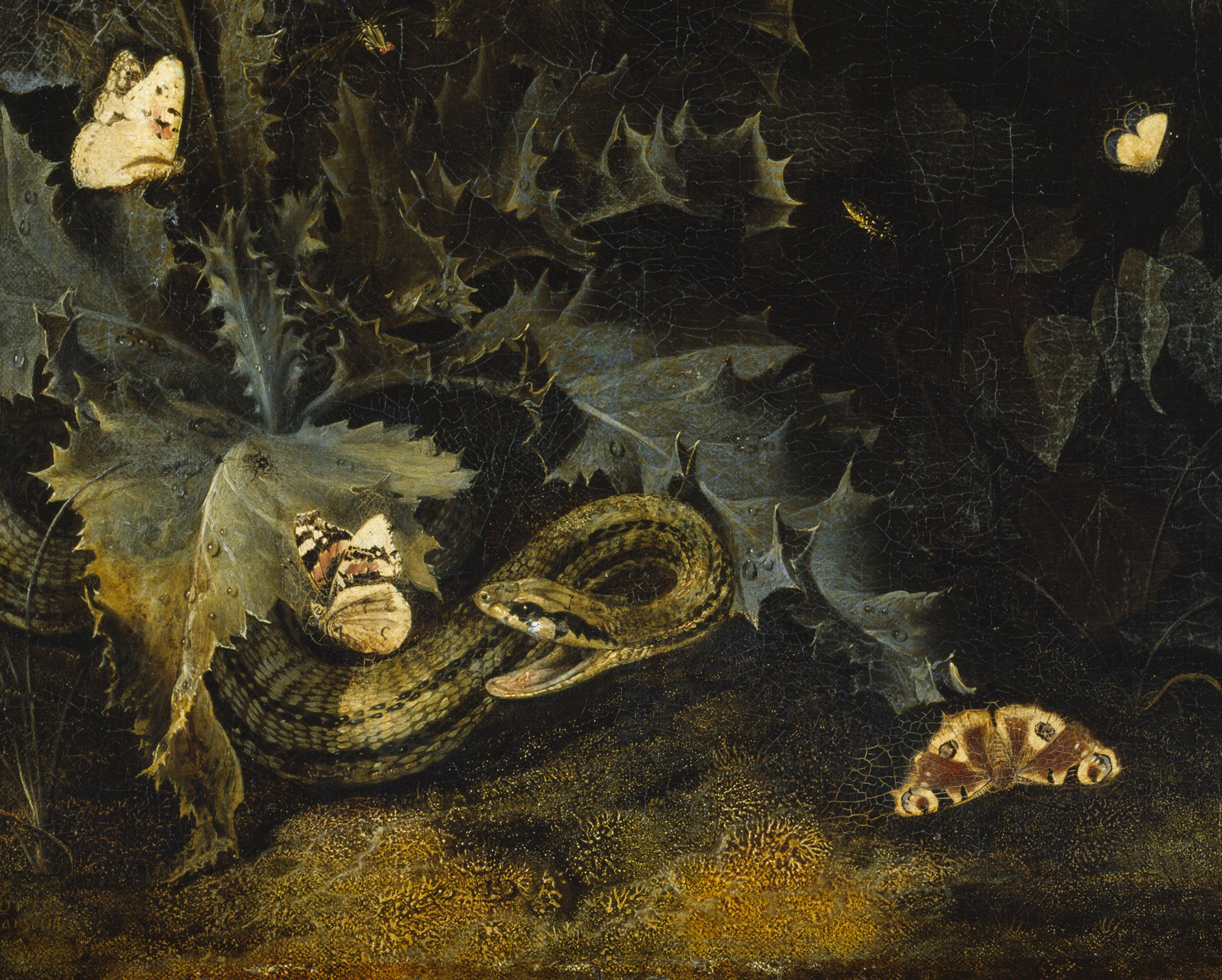
We’re continuing our deep dive into the Ashtavakra Gita. It really is a lovely text, reminding us over and over again that what we are is so much more interesting than what we are not. This despite cultural conditioning that tricks us into thinking we are what we think, believe, remember, etc…
I’m currently down with a bad cold and feel kind of awful. Just a few days ago I was not down with a bad cold and felt kind of great. Is one more real than the other? They sure feel different. But the me who’s feeling, the me sitting inside my awareness, this “me” feels exactly the same.
This me is so much deeper than transitory states of sickness and health, loss and gain, happy and sad, up and down. It just sits here, resting in its own light. Steady, vibrant, and crystal clear…
We all know this. But the way the mind works, we need to be reminded over and over again. And the Ashtavakra Gita is a great medicine for remembering…
Along with this text, I also referenced everybody’s favorite, the five primal causes of suffering known as the kleshas. These are spelled out in the yoga-sutra. If you need a refresher on these lovelies, here you go:
Avidya is the lens that clouds our ability to know what we truly are, keeping us caught in the forest of ignorance…
Asmita is the lens that tricks us into small self identification, i.e. the ego or “I-maker.”
Raga is pleasure, which, when tangled up with avidya and asmita, gets us all caught up in clinging to what makes us feel good.
Dvesha is aversion, which when tangled up with avidya and asmita, creates a profound separation from everything and anything we label as “bad.”
Abinivesha is clinging to life (or any situation) because we fear death (or change).
Because the Ashtavakra Gita is such a love song to the Self, we’ve been mostly chanting om namah shivaya. Which is such a sonic embodiment of the Self…
Here’s opening chanting. This is very slow ONS.
Here is this week’s dharma talk.
Here’s the text we read from Ashtavakra Gita.
8.
“I do this. I do that.”The big black snake of selfishnessHas bitten you!“I do nothing.”This is the nectar of faith,So drink and be happy!9.Know you are one,Pure awareness.With the fire of this conviction,Burn down the forest of ignorance.Free yourself from sorrow,And be happy!10.Be happy!For you are joy, unbounded joy.You are awareness itself.Just as a coil of ropeIs mistaken for a snake,So you are mistaken for the world.11.If you think you are free,You are free.If you think you are bound,You are bound.For the saying is true:You are what you think.12.The Self looks like the world.But this is just an illusion.The Self is everywhere.One.Still.Free.Perfect.The witness of all things,AwarenessWithout action, clinging or desire.
Here’s the Mary Oliver poem that sums it up way more eloquently
than I am able…
OUT OF THE STUMP ROT, SOMETHING
Mary OliverOut of the stump rot
something
glides forward
that is not a rope,unless a rope has eyes,
lips,
tongue like a smack of smoke,
body without shoulders.Thus: the black snake
floating
over the leaves
of the old yearand down to the pond,
to the green just beginning
to fuzzle out of the earth,
also, like smoke.If you like a prettiness,
don’t come here.
Look at pictures instead,
or wait for the daffodils.This is spring,
by the rattled pond, in the shambled woods,
as spring has always been
and always will beno matter what we do
in the suburbs.
The matted fur,
the red blood,the bats unshuttering
their terrible faces,
and black snake
gliding across the fieldyou think you own.
Long neck, long tail.
Tongue on fire.
Heart of stone.[from A Thousand Mornings]
I’m writing at 7:24 pm on Thursday, March 14. We are at this moment five days, 35minutes, and ten seconds from the Vernal Equinox. Cosmic rhythms not withstanding, today sure feels like Spring. I opened all the windows in my house. Which felt amazing. And reminded me of those sublime lines from the Kabir/Bly poem:
Open the window to the west and disappear into the air inside you….
Which is really what Monday Night Class is about. Disappearing into the air inside us where we find the everything-ness that is us…
This week’s class begins a new cycle of disappearing into that everything-ness, articulated so beautifully in Thomas Byrom’s gorgeous translation of the Ashtavakra Gita.
This text comes down through the tradition of Advaita Vedanta, a beautiful philosophical system that has a non-dual view of Reality. Advaita means one, not two, and in this paradigm, there is no mind/body, spirit/matter split. There is only Brahman, pure consciousness, i.e. the everything-ness…
This is a very different view from the Sankhya tradition, which, fyi, contains the philosophy of Yoga, where spirit and matter are considered separate. Dualistic though it is, there’s great beauty in Sankhya. One just has to read between the lines. And while I’m adding caveats, let me also say, full disclosure, that while there’s a lot I like in the Advaita Vedanta paradigm, my preference is still Shaktism/Shaivism.
This however, is a conversation for another time…
This week’s dharma talk gathers much of the above, soaring around in the sublimity of it all, while, I hope, grounding it in something relevant and helpful to living our lives. One can endlessly philosophize, but really, if we’re not embodying, it’s just a lot of blather…
Here are audio clips from this week’s class:
OPENING MANTRA (OM NAMAH SHIVAYA) AND DHARANA
DHARMA TALK
CLASS CHANTING OM NAMAH SHIVAYA
CLOSE OF CLASS
Here’s the text we read this week:
[from Thomas Byrom’s translation of the Ashtavakra Gita]1. The Self1.O Master,Tell me how to findDetachment, wisdom, and freedom!2.Child,If you wish to be free,Shun the poison of the senses.Seek the nectar of truth,Of love and forgiveness,Simplicity and happiness.3.Earth, fire and water,The wind and the sky —You are none of these.If you wish to be free,Know you are the Self,The witness of all these,The heart of awareness.4.Set your body aside,Sit in your own awareness.You will at once be happy,Forever still,Forever free.5.You have no caste.No duties bind you.Formless and free,Beyond the reach of the senses,The witness of all things.So be happy.6.Right or wrong,Joy or sorrow,These are of the mind only.They are not yours.It is not really youWho acts or enjoys.You are everywhere,Forever free.7.Forever and truly free,The single witness of all things.But if you see yourself as separate,Then you are bound.
This final poem never made it into the recording, but here’s the Mary Oliver I read at the end of class. This is from her collection, Blue Horses.
I’M NOT THE RIVER
I’m not the river
that powerful presence.
And I’m not the black oak tree
which is patience personified.
And I’m not redbird
who is a brief life heartily enjoyed.
Nor am I mud nor rock nor sand
which is holding everything together.
No, I am none of these meaningful things, not yet.
This poem is glorious on its own. In the context of this week’s class, it takes on even more meaning. One of the key inquires of Vedanta is to discover what one is by naming what one is not, i.e. I am not this body, I am not this mind, etc. etc.
They call it neti neti, not this, not this…
I’ve no idea if Oliver is purposely riffing on this, or simply airing her wide spacious mind. Either way, the poem is a gorgeous flip of the whole notion of neti neti…
And she manages to do this with two simply words, “not yet.”
I’ve been thinking a lot about inner stillness, and about inner silence. How these two are so connected, perhaps even one and the same. What are they really? Inner Stillness. Inner Silence. Can they be described at all? Or are they so beyond beneath all encompassing that words can only hint at them? And is the hinting more than enough?
I don’t have answers to these questions.
But I do like sitting with them…
Last night was Mahashivatatri, the Great Night of Shiva, the Great Stillness. So at class, we mostly chanted om namah shivaya. It’s such a beloved practice. Even for people who don’t like it 😉 Such a practice of the Heart. My teacher Muktananda called it “the great redeeming mantra.” It is that and more. It’s both a portal into, a vehicle of, and a sonic embodiment of the great stillness, the great silence.
Here’s audio from this week’s class:
This is the opening dharana, first round of chanting ONS, my dharma talk which includes a poem from Mary Oliver, and more chanting ONS.
This is a reading from the Asthavakra Gita, a bit more mantra, and the close of class
For those who can’t get enough, this is me singing solo before class.
Finally, here’s text of this week’s readings.
Varanasi
from A Thousand Mornings, by Mary Oliver
Early in the morning we crossed the ghat,
where fires were still smoldering,
and gazed, with our Western minds, into the Ganges.
A woman was standing in the river up to her waist;
she was lifting handfuls of water and spilling it
over her body, slowly and many times,
as if until there came some moment
of inner satisfaction between her own life and the river’s.
Then she dipped a vessel she had brought with her
and carried it filled with water back across the ghat,
no doubt to refresh some shrine near where she lives,
for this is the holy city of Shiva, maker
of the world, and this is his river.
I can’t say much more, except that it all happened
in silence and peaceful simplicity, and something that felt
like the bliss of a certainty and a life lived
in accordance with that certainty.
I must remember this, I thought, as we fly back
to America.
Pray God I remember this.
19.My Own Splendor1.With the pincers of truth I have pluckedFrom the dark corners of my heartThe thorn of many judgments.2.I sit in my own splendor.Wealth of pleasure,Duty or discrimination,Duality or nonduality,What are they to me?3.What is yesterday,Tomorrow,or today?What is space,Or eternity?I sit in my own radiance.4.What is the Self,Or the not-Self?What is thinking,Or not thinking?What is good or evil?I sit in my own splendor.5.I sit in my own radiance,And I have no fear.Waking,Dreaming,Sleeping,What are they to me?Or even ecstasy?6.What is far or near,Outside or inside,Gross or subtle?I sit in my own splendor.7.Dissolving the mind,Or the highest meditation,The world and all its works,Life or death,What are they to me?8.Why talk of wisdom,The three ends of life,Or onesness?Why talk of these!Now I live in my heart.
JANUARY 14. 2019 MONDAY NIGHT CLASS
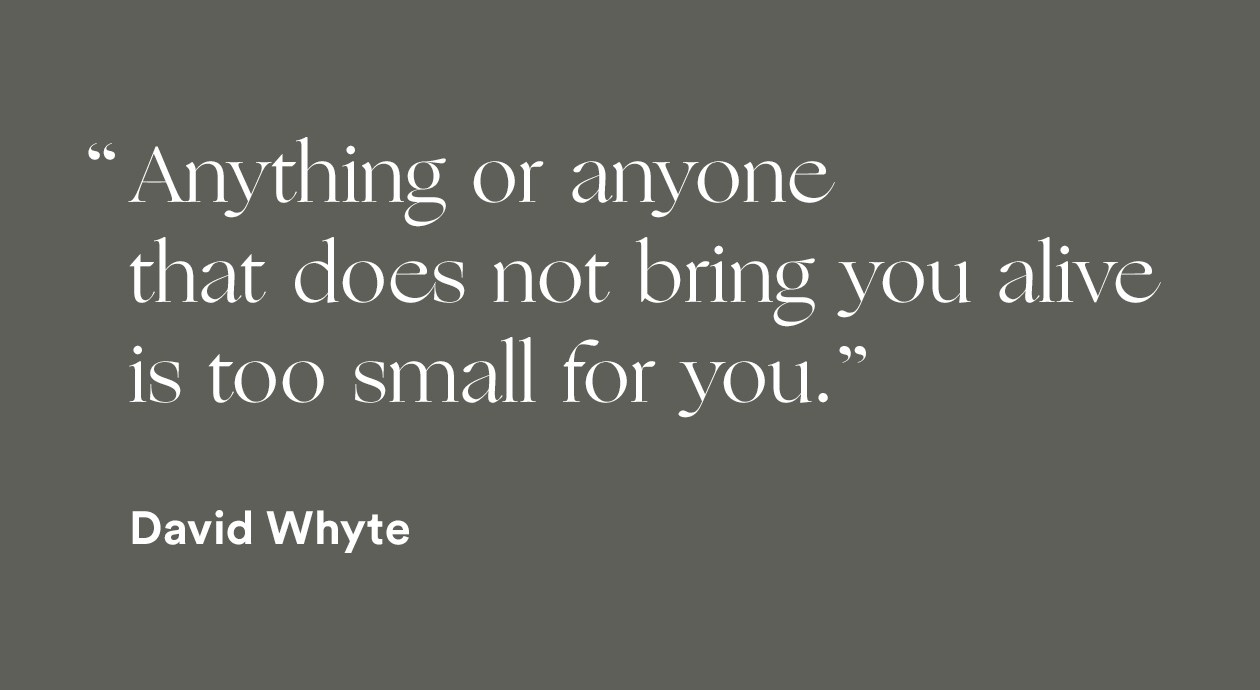
I so love the above quote from David Whyte. I think he says it so beautifully. There is simply no good reason for us to keep company with anything or anyone that does not bring us alive, with anything or anyone that tries to keep us small.
Choose your greatness…
Here are audio clips and readings from the first class of this new year.
Here’s opening chanting of Om Tara Tuttare Ture Swaha.
Here’s the opening dharana and my dharma talk.
Here’s chanting of Vakratunda II and the Surya Bija Mantra. These are fine for people who want to chant along, but the album tracks are way better for listening. You can find VakII on Sound Cloud and the Surya Bija mantra track is on our Sun Mantras album.
Here are this week’s readings.
TAO TE CHING
32.
The Tao can’t be perceived.
Smaller than an electron,
it contains uncountable galaxies.If powerful men and women
could remain centered in the Tao,
all things would be in harmony.
The world would become a paradise.
All people would be at peace,
and the law would be written in their hearts.When you have names and forms,
know they are provisional.
When you have institutions,
know where their functions should end.
Knowing when to stop,
you can avoid any danger.All things end in the Tao
as rivers flow into the sea.YOGA-SUTRA
1.1 Atha yoganushasanan (Now, the study of Yoga.)
1.2 Yogah chitta vritti nirodhaha (Yoga is the stilling of the thought waves in the mind.)
1.3 Tada drashtu svarupe avasthanam (Then we rest in our essential nature.)
Here are the words to Vakratunda II.
vakratunda mahakāya
suryakoti samaprabha
nirvighnam kuru me deva
sarva kāryeśu sarvadaom gang ganapataye namaha
As always, the final word goes to Mary Oliver. Particularly poignant this week…
SUNRISE
Mary Oliver
You can
die for it —
and idea,
or the world. Peoplehave done so,
brilliantly,
letting
their small bodies be boundto the stake,
creating
an unforgettable
fury of light. Butthis morning,
climbing the familiar hills
in the familiar
fabric of dawn, I thoughtof China,
and India
and Europe, and I thought
how the sunblazes
for everyone just
so joyfully
as it rises
under the lashes
of my own eyes, and I thought
I am so many!
What is my name?What is the name
of the deep breath I would take
over and over
for all of us? Call itwhatever you want, it is
happiness, it is another one
of the ways to enter
fire.

As I’m sure most everyone reading this knows, Mary Oliver left this world two days ago. And the world feels somehow different without her. Lonely.
I keep thinking about the way she looked and in her looking, saw so deeply.
She looked. She saw. She took in. She made communion, over and over again.
Who will look the way she did? Who will see the way she saw. We have lost a beloved poet-seer of our time. We have lost one of the great ones.
I never got to meet Mary Oliver. I did buy her books. Lots of them. And am thinking I must now buy the ones I don’t already own. I don’t have shelf space for them. But it seems the best tribute I can make.
She leaves the finest footprint on this earth, zillions of fans who love her and a trail of words, 37 books if I count correctly, imbued with such truth and beauty. Keats would approve. If there’s a poet’s heaven, they are no doubt sitting together, laughing…
Especially at her nose-in-the-air critics who call her poems too simple. Oh please. I read her poetry over and over and every time, discover something new. If her poems are too simple, let us have more and more of that simplicity.
She was a master.
I celebrate her life and grieve her death. She is gone just a couple of days and already so missed. The trees and the swans and the toads and the frogs. The songbirds and the fish and the deer. The dogs and the roses. The blueberries. The goldenrod. The light. Of everything and everyone she sang, to everything and everyone she sang.
I keep thinking of her final breath. I imagine her lying there, gazing at this world she loved so much, breathing it in one last time and smiling, as she slipped from the form of her body and merged into that ineffable spaciousness, that vibrant luminosity she somehow managed to gather and hold in her poems…
Messenger
-Mary OliverMy work is loving the world.
Here the sunflowers, there the hummingbird –
equal seekers of sweetness.
Here the quickening yeast; there the blue plums.
Here the clam deep in the speckled sand.Are my boots old? Is my coat torn?
Am I no longer young and still not half-perfect? Let me
keep my mind on what matters,
which is my work,which is mostly standing still and learning to be astonished.
The phoebe, the delphinium.
The sheep in the pasture, and the pasture.
Which is mostly rejoicing, since all ingredients are here,Which is gratitude, to be given a mind and a heart
and these body-clothes,
a mouth with which to give shouts of joy
to the moth and the wren, to the sleepy dug-up clam,
telling them all, over and over, how it is
that we live forever.
10.8.18. THE DHARMA OF SPEECH. SPEAK ONLY THAT WHICH IS KIND, TRUE, NECESSARY, AND AT THE APPROPRIATE TIME.
I’m still getting over a very bad cold so will keep this post brief. This week’s class centered around one of my favorite teachings, The Dharma of Speech. And went on from there to encompass the beautiful Tara mantra, om tara tuttare ture swaha; a verse from Mary Oliver’s astonishing riff on the 145th Psalm; a particularly luminous verse from the Tao Te Ching; and a story from Robert Greene’s 48 Laws of Power. While at its root this story is the antithesis of the dharma of speech, still, it makes a fun complement to our contemplation…
Here’s the opening dharana on Tara:
Here’s my dharma talk:
And here are the readings:
Tao Te Ching, Verse 21
The Master keeps her mind
always at one with the Tao;
that is what gives her radiance.The Tao is ungraspable.
How can her mind be at one with it?
Because she doesn’t cling to ideas.The Tao is dark and unfathomable.
How can it make her radiant?
Because she lets it.Since before time and space were,
the Tao is.
It is beyond is and is not.
How do I know this is true?
I look inside myself and see.* * *
On Thy Wondrous Works I Will Meditate(Psalm 145)
Mary Oliver
7.
I know a man of such
mildness and kindness it is trying to
change my life. He does not
preach, teach, but simply is. It is
astonishing, for he is Christ’s ambassador
truly, by rule and act. But, more,he is kind with the sort of kindness that shines
out, but is resolute, not fooled. He has
eaten the dark hours and could also, I think,
soldier for God, riding out
under the storm clouds, against the world’s pride and unkindness,
with both unassailable sweetness, and consoling word.published in Devotions, p. 137.
* * *
from The 48 Laws of Power, by Robert Greene
Down on his luck, the screenwriter Michael Arlen went to New York in 1944. To drown his sorrows he paid a visit to the famous restaurant “21.” In the lobby, he ran into Sam Goldwyn, who offered the somewhat impractical advice that he should buy racehorses. At the bar, Arlen met Louis B. Mayer, an old acquaintance, who asked him what were his plans for the future. “I was just talking to Sam Goldwyn…” began Arlen. “How much did he offer you?” interrupted Mayer. “Not enough,” he replied evasively. “Would you take fifteen thousand for thirty weeks?” asked Mayer. No hesitation this time, “Yes,” said Arlen. [p. 32]
After weeks of brutal heat and humidity, the rains and cool weather have come. Reminding me that nothing, NOTHING, is forever. And while everyone tells me I don’t look or seem my 70 years, the reality is, I’m standing on seven decades. I now know in my bones what I only knew in my mind even just a few years ago. Every moment is a blessing and a gift. Cherish it…
Class has resumed after a long summer break. And what a joy to be back in the Monday Night groove. Driving to class I was listening to an All Things Considered interview with Sally Fields who cites the quote (attributed to George Eliot) with which I’ve titled this post. It’s never too late to become what you might have been…
Yes.
This is the truth.
Here’s this week’s dharma talk and reading from David Whyte’s book of essays, Consolations.
This passage from David Whyte perfectly articulates my feelings about the essence of what class, in fact, what all of my work is about…
…the ultimate touchstone of friendship is not improvement, neither of the other nor of the self, the ultimate touchstone is witness, the privilege of having been seen by someone and the equal privilege of being granted the sight of the essence of another, to have walked with them and to have believed in them, and sometimes just to have accompanied them for however brief a span, on a journey impossible to accomplish alone.
Here’s audio of class chanting. With apologies for recording quality. Daniel was at class so listen for his amazing tabla…
The Mangalam
Gayatri and Om Namah Shivaya Mantras
I came down to my office a couple of weeks ago. It was early morning and I needed to get something. Once down here, I thought I’d check the AC filter. I was expecting dust and cat hair. What I found was a small handful of ants. A bit of a shock but nothing I couldn’t handle. I took the whole mess outside, sent them on their way, and slipped the filter back into place. Or tried to. Except I couldn’t get it back in. And since I’d turned the unit off before pulling out the filter, and since it was already hot and humid outside, the room was heating up.
It was only then, so intent had I been on the filter, that I noticed the real problem. A huge stream of ants was pouring in through a tiny opening at the seam where the window meets the wall. Hundreds of ants, winged and wingless, invading my now sweltering office.
I raced upstairs, grabbed the vacuum, brought it down, plugged it in, and began my attack. It was brutal. I was brutal. It was overwhelming. I was overwhelmed. And those ants kept coming. At a certain point, I had a moment of pure terror.
And that was when it hit me. I realized that what I was feeling was not so different from what people opposed to immigration feel. My border was breached and I was desperate to protect it. That was the moment my heart opened.
Which is not to say I’ve changed my position on immigration, refugee crises, and open borders. I have not. Closed borders make no sense to me. I’m as engaged as I can be in the fight to right what I believe is a terrible wrong. But those ants showed me I’m not so different from those “others” I tend to vilify. We may profoundly disagree. But I am damned if I’m going to let my heart close down. The ants taught me that.
There is no great moral to this story. I tell it to bear witness to my determination to stay open to people with whom I disagree. It’s really that simple. If I’ve learned one thing in seven decades of life, it’s that staying open is actually much safer than shutting down. And a whole lot more interesting.
I’ve been catching up on Krista Tippett’s On Being podcasts this week. If you’d like some excellent soul medicine for staying open, I highly recommend her conversation with Luis Alberto Urrea. Click here to listen.
March 11, 2018. A week ago, it seemed like Spring. And then a wild crazy nor’easter blew in. The Mother of All Storms. Thick heavy snow coming down a mile a minute. Thunder and lightning adding to the show. Trees down, power out, and the time that rules the dance of daily life stood still. Truth be told, I rather like these times that are, in their way, outside of time. In the space between…
Years ago I was in a meditation retreat with Baba Muktananda. He was teaching the ham-sa mantra. Part of the practice was to focus our awareness on the space between the breaths. To remain in that spaciousness for as long as we could, Four, five, six, seven, eight, nine, maybe ten seconds. He showed us how in that space between the breaths, we touch eternity, poised outside the limiting constructs of time…
One of the curious experiences I had during that weekend retreat was excruciating pain in my left hip. Which began in the Saturday morning session and continued through the closing on Sunday night. Ardent yogini that I was, I soldiered through. And here’s the thing. At the end of the retreat, the pain was gone. Gone. And has never returned…
Was the pain — and I am talking about 48 hours of non-stop physical agony — a kriya, an illusion, something burning up? I will never know. But it did teach me that what I perceive and what is actually happening are not necessarily the same. That when I think I know, or as the Tao Te Ching verse quoted above says, when I presume to know, the odds are, knowledge is not happening….
It’s a tricky business, this knowing and not-knowing, this “I” with all its presumptions, agendas, associations, projections, and attachments. It really does close up the space. And I won’t say I know this. But I sure do feel it in my bones. The spaciousness of that space between the breaths, that’s where it’s all happening. Or not-happening. That is where I want to live.
Here’s my dharma talk from Monday, December 4th. It could be called, What we are is so much more interesting than what we think we should be…. This is a rather freewheeling talk with a handful of LOL moments.
AUDIO OF DECEMBER 4, 2017 DHARMA TALK
AUDIO OF ON TARA TUTTARE TURE SWAHA OPENING OF CLASS
AUDIO OF NAVARNA AND OM NAMAH SHIVAYA MANTRAS
THE TEXTS
We were reading this text back-to-front but this verse called for a front-to-back context so I also read the two preceding verses. I’m copying them here in that order…
72.
When they lose their sense of awe,
people turn to religion.
When they no longer trust themselves,
they begin to depend upon authority.Therefore the Master steps back
so that people won’t be confused.
He teaches without teaching,
so that people will have nothing to learn.70.
My teachings are easy to understand
and easy to put into practice.
Yet your intellect will never grasp them,
and if you try to practice them, you’ll fail.My teachings are older than the world.
How can you grasp their meaning?If you want to know me,
look inside your heart.71.
Not-knowing is true knowledge.
Presuming to know is a disease.
First realize that you are sick;
then you can move towards health.The Master is her own physician.
She has healed herself of all knowing.
Thus she is truly whole.
Prepping for this class which happened to fall on a Super Moon evening, this poem from Lex Hixon’s Mother of the Universe, jumped out off the page. This book used to be my go-to text. As I’ve grown simpler with age however, Lex’s versions of Ramprasad strike me as being a bit too thick. I want everything pared down to its essence. Reading this poem over and over though and typing it out just now, well, let me say that myriad adjectives not withstanding, it’s a rather potent map. And quite soaring.
I am a child reaching out to catch the moon
Ramprasad/Lex HixonWho in the world can know what Mother Kali really is?
She is beyond the reach of every scripture,
every system of philosophy.As the radiant blackness of divine mystery,
she plays through the lotus wilderness of the sacred human body.
The practitioner of meditation encounters her power
deep in the blossom of primordial awareness
and within the thousand-petal lotus
that floats far above the mind.Kali is the conscious core,
shining through every awakened sage
who delights in oneness.
This has been demonstrated by countless realized beings.
Ma Tara is the queen of freedom within all hears.
She reigns timelessly and tenderly.
Planes and dimensions of being
more vast and subtle than anyone can imagine
are found within her womb of encompassing wisdom.
The Goddess alone knows the extent of her power.
Who else could possibly know?Laments the singer of this mystic hymn:
“Everyone will laugh at my attempt to swim
the shoreless sea of her reality,
but my soul belongs to her
and my heart delights in longing.
I am a child reaching out to catch the moon.”
As usual, the final word goes to Mary Oliver. This poem is vast. We can read it over and over again, and always discover something new…
The Mockingbird
Mary OliverAll summer
the mocking bird
in his pearl-gray coat
and his white-windowed wingsflies
from the hedge to the top of the pine
and begins to sing, but it’s neither
lilting nor lovely,for he is the thief of other sounds–
whistles and truck brakes and dry hinges
plus all the songs
of other birds in his neighborhood;mimicking and elaborating,
he sings with humor and bravado
so I have to wait a long time
for the softer voice of his own lifeto come through. He begins
by giving up all his usual flutter
and setting down on the pine’s forelock
then looking aroundas though to make sure he’s alone;
then he slaps each wing against his breast,
where his heart is,
and, copying nothing, beginseasing into it
as though it was not half so easy
as rollicking,
as though his subject nowwas his true self,
which of course was as dark and secret,
as anyone else’s
and it was too hard—
perhaps you understand—
to speak or to sing it
to anything or anyone
but the sky.
 The Monday Night Blog